
History-Periods
Past eras

From pre-history to today
Choose your period

Pre history - Present
explore the different eras
Past eras
Choose your period
explore the different eras
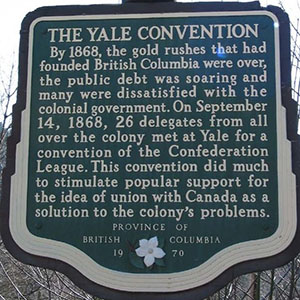
The Yale Convention was a series of meetings held in Yale, British Columbia in 1868 to discuss the possibility of British Columbia joining the Confederation of Canada. The meetings were attended by prominent politicians, business leaders, and First Nations leaders, and resulted in the creation of a series of resolutions that were sent to the Canadian government. The resolutions outlined the terms and conditions under which British Columbia would agree to join the Confederation, including the construction of a transcontinental railway, the protection of First Nations rights, and the establishment of a secure and efficient system of government. The Yale Convention was an important step in the process of British Columbia joining the Confederation, and its resolutions played a significant role in shaping the terms of union between the two.
The main issue being discussed at the Yale Convention was whether or not British Columbia should join the Confederation of the British North American provinces, which had been established in 1867. The convention was attended by representatives from the various communities and First Nations in the colony, as well as by a number of politicians and officials.
After several days of discussion and debate, the delegates at the Yale Convention ultimately voted to reject the proposal to join Confederation. However, the colony eventually did join Confederation in 1871, becoming the sixth province of Canada.
At the end of the convention, the delegates voted to reject the proposal to join Confederation. However, the colony eventually did join Confederation in 1871, becoming the sixth province of Canada.
The question of whether the general population in British Columbia supported Confederation with Canada was a matter of significant debate and division at the time. There were vocal supporters of Confederation who believed that joining Canada would bring economic and political benefits to the colony, while others were opposed to the idea, fearing that it would result in the loss of local autonomy and control over resources.
One of the key factors that led to increased support for Confederation was the economic situation in British Columbia at the time. The colony was facing a recession, and many people believed that joining Canada would bring new economic opportunities, such as access to new markets and increased investment.
The decision to join the Canadian Confederation was ultimately made by the government of British Columbia and the federal government in Ottawa, and it was ratified by a majority of voters in the province in a referendum held in 1871. While the discussions at the Yale Convention may have contributed to the decision to join Confederation, it was not a formal vote taken at the convention that led to British Columbia becoming part of Canada.
Despite these concerns, a majority of voters in British Columbia ultimately voted in favor of joining the Canadian Confederation in a referendum held in 1871. The terms of British Columbia's entry into Confederation included several concessions, such as the construction of a transcontinental railway and increased representation in the federal government. While there were still many who opposed Confederation, it became the accepted political reality in British Columbia and helped to shape the province's political and economic development in the years that followed.
Timeline
one of the key issues discussed at the Yale Convention was the possibility of British Columbia joining the Canadian Confederation. The delegates at the convention discussed various options for building support for Confederation, including the possibility of negotiating better terms for British Columbia within Confederation, such as better transportation links and increased representation in the federal government.
The idea of joining the Canadian Confederation had been a contentious issue in British Columbia for several years prior to the Yale Convention, with many residents divided on the issue. Some saw Confederation as a way to address the economic and political challenges facing the colony, while others feared losing their independence and being subject to the decisions of the federal government.
The discussions at the Yale Convention contributed to the eventual decision to join the Canadian Confederation in 1871. The terms of British Columbia's entry into Confederation included several concessions, such as the construction of a transcontinental railway and increased representation in the federal government.
British Columbiahistory.ca is a visitor supported web site. If you would like to submit an article or opinion, please visit our blog at www.blog.British Columbiahistory.ca.
Reference: Article by (Staff Historian), 2023
Tel: 1 604 833-9488
Email: info@canadahistorysociety.ca

All content and images are protected by copyright to Access History