
History-Periods
Past eras

From pre-history to today
Choose your period

Pre history - Present
explore the different eras
Past eras
Choose your period
explore the different eras
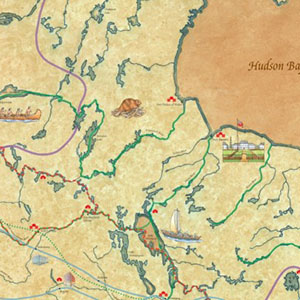
The Hudson's Bay Company and the Northwest Territories are two important aspects of Canada's history. The Hudson's Bay Company was a fur trading company that played a significant role in the exploration and development of Canada, while the Northwest Territories was a vast region that covered a significant portion of northern Canada. This essay will provide a detailed overview of the Hudson's Bay Company and the Northwest Territories and their transfer to Canada.
The Hudson's Bay Company was established in 1670 by English traders who sought to profit from the fur trade in North America. The company was granted a charter by King Charles II, which gave it exclusive trading rights over a vast region that included what is now northern Ontario, Manitoba, Saskatchewan, Alberta, and parts of Quebec, the Northwest Territories, and Nunavut. The company built trading posts along the coast of Hudson Bay and established relationships with Indigenous communities in the region. The fur trade was the main source of income for the company, and it played a significant role in the exploration and development of Canada.
In the early 19th century, the Hudson's Bay Company expanded its operations into the interior of Canada, establishing trading posts along the major rivers and lakes. The company also played a significant role in the westward expansion of Canada, as it provided supplies and transportation services to settlers and explorers who were heading west. However, the company's dominance in the fur trade began to decline in the mid-19th century as other companies, such as the North West Company and the American Fur Company, began to compete with it.
The Northwest Territories, on the other hand, was a vast region that covered a significant portion of northern Canada. The region was first explored by European explorers in the 17th century, but it was not until the 18th and 19th centuries that significant exploration and settlement occurred. The Northwest Territories were originally part of the Rupert's Land, which was controlled by the Hudson's Bay Company. However, in 1870, the British government transferred control of the region to Canada.
The transfer of the Northwest Territories to Canada was part of a larger process of nation-building that occurred in the late 19th century. Canada was expanding rapidly, and the government sought to assert its authority over all regions of the country. The transfer of the Northwest Territories was also motivated by concerns about American expansionism and the need to secure Canada's northern borders.
The transfer of the Northwest Territories to Canada was not without controversy. Indigenous peoples in the region were not consulted or included in the negotiations, and many felt that their rights and interests were ignored. The transfer also led to conflicts between the Canadian government and Métis communities in the region, who felt that their rights and interests were not being protected.
In conclusion, the Hudson's Bay Company and the Northwest Territories played significant roles in the exploration and development of Canada. The Hudson's Bay Company was a key player in the fur trade and played a significant role in the westward expansion of Canada. The Northwest Territories were a vast and important region that was transferred to Canada in 1870 as part of the nation-building process. While the transfer was not without controversy, it marked an important milestone in the history of Canada and helped to shape the country's northern borders and identity.
The transfer of the Northwest Territories and the creation of the province of Manitoba played an important role in British Columbia's decision to join Confederation in 1871. British Columbia had initially been hesitant to join Confederation, as the province was separated from the rest of Canada by vast distances and had significant economic ties with the United States.
However, the creation of the province of Manitoba and the recognition of Indigenous land rights in the region helped to address some of the concerns that had initially led British Columbia to hesitate. The recognition of Indigenous land rights was an important signal to British Columbia that the Canadian government was committed to protecting the rights of Indigenous peoples, which was a key concern for many British Columbians.
In addition, the creation of the province of Manitoba helped to demonstrate that Confederation was a flexible and adaptable system that could accommodate the needs and interests of diverse regions and populations. British Columbia had been concerned that Confederation would be dominated by central Canadian interests, but the creation of Manitoba suggested that there was room for local autonomy and representation within the federation.
Finally, the transfer of the Northwest Territories helped to secure Canada's northern borders, which was a key concern for British Columbia given its proximity to the United States. The transfer helped to establish Canada's territorial integrity and demonstrated the country's ability to defend its borders and assert its sovereignty.
Overall, the transfer of the Northwest Territories and the creation of the province of Manitoba helped to address some of the concerns that had initially led British Columbia to hesitate about joining Confederation. The recognition of Indigenous land rights, the demonstration of a flexible and adaptable federation, and the securement of Canada's northern borders all helped to persuade British Columbia to join Confederation and become part of the Canadian family.
Timeline
The transfer of the Northwest Territories to Canada in 1870 was a complex process that had significant implications for the Indigenous peoples of the region, including the Métis. The Métis were a distinct people with a mixed Indigenous and European heritage who had settled in the region and played a significant role in the fur trade. The transfer of the Northwest Territories to Canada led to conflicts between the Canadian government and the Métis, who felt that their rights and interests were not being protected.
One of the key issues was the lack of consultation with Indigenous peoples, including the Métis, in the negotiations leading up to the transfer. The Métis felt that they had not been given a voice in the process and that their interests had been ignored. In particular, they were concerned about the impact of the transfer on their land rights and their ability to continue their way of life.
The Métis also had specific grievances related to the Hudson's Bay Company, which had controlled the region for many years. The company had granted land to Métis families, but many of these land grants were not recognized by the Canadian government after the transfer. This led to disputes over land ownership and a sense of betrayal among the Métis.
In addition to these issues, there were broader tensions between the Métis and the Canadian government related to language and culture. The Métis spoke Michif, a unique language that combines elements of French and Cree, but the Canadian government did not recognize it as an official language. The Métis also had a distinct culture and way of life that was different from that of the European settlers who were moving into the region.
These tensions came to a head in 1869-70 with the Red River Rebellion, which was led by Métis leader Louis Riel. The rebellion was sparked by concerns about the impact of the transfer on Métis land rights and the lack of consultation with Indigenous peoples. Riel formed a provisional government and demanded that the Canadian government negotiate with the Métis and respect their rights.
The Canadian government eventually sent a delegation to negotiate with Riel and the Métis, which led to the Manitoba Act of 1870. The act created the province of Manitoba and recognized the Métis land claims in the region. The act also recognized French as an official language and provided for separate schools for Catholics and Protestants.
While the Manitoba Act was a significant step forward for the Métis, it did not fully address all of their concerns. The Métis continued to face challenges related to land ownership, language, and cultural recognition in the years that followed. Nevertheless, the act represented an important recognition of the rights and interests of the Métis and helped to establish the foundation for the recognition of Indigenous rights in Canada more broadly.
British Columbiahistory.ca is a visitor supported web site. If you would like to submit an article or opinion, please visit our blog at www.blog.British Columbiahistory.ca.
Reference: Article by (Staff Historian), 2023
Tel: 1 604 833-9488
Email: info@canadahistorysociety.ca

All content and images are protected by copyright to Access History