
History-Periods
Past eras

From pre-history to today
Choose your period

Pre history - Present
explore the different eras
Past eras
Choose your period
explore the different eras
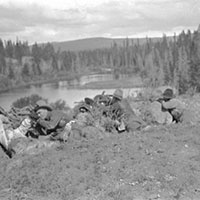
The Chilcotin War was a conflict that took place in British Columbia, Canada in 1864. The war was sparked by the killing of several white settlers by a group of Chilcotin Indigenous people, who were angry over the theft of their land and the destruction of their traditional way of life by the settlers. The Chilcotin were led by a chief named Klattasine and the war was fought between a group of Chilcotin warriors and a detachment of British Columbia colonial forces.
During the time of the Chilcotin War, there were plans to build a road through the Chilcotin territory by the British Columbia colonial government. The road, known as the "Butler's Road," was proposed by a man named Alfred Waddington, who was a businessman and prospector interested in developing the region's resources. He proposed the construction of a road that would connect the colony's capital, Victoria, with the goldfields in the Interior of British Columbia.
Waddington's proposal was met with resistance from the Chilcotin people, who saw the construction of the road as a further encroachment on their land and a threat to their way of life. The Chilcotin War broke out shortly after the plans to build the road were announced. Although the road was never completed, the conflict was in part sparked by the proposed road, and the plan to build it added to the existing tensions and mistrust between the settlers and the Indigenous people.
The colonial forces that fought in the Chilcotin War were made up of a detachment of the British Columbia colonial government's volunteer militia, which was known as the British Columbia Volunteer Rifles. The unit was composed of white settlers, gold prospectors, and other civilians who had volunteered to fight against the Chilcotin people. The unit was led by a British officer named William Cox, who was appointed by the Governor of British Columbia to lead the expedition against the Chilcotin. Additionally, a group of hired local Indigenous people, known as the "friendly" or "allied" tribes, also served as scouts and guides for the colonial forces. The colonial forces were supported by the British Royal Navy and the Hudson's Bay Company, which provided supplies and logistics for the expedition.
The war ended with the capture and execution of Klattasine and several other Chilcotin leaders, and the forced relocation of the remaining Chilcotin people. The conflict was a result of the expansion of the British colony into the Chilcotin territory, which was met with resistance from the Indigenous peoples.
Timeline
The aftermath of the Chilcotin War had a lasting impact on the Chilcotin people and the British Columbia colony.
The Chilcotin people: The Chilcotin warriors who were captured were executed, and the remaining Chilcotin people were forced to relocate to a reservation. This forced relocation resulted in the loss of their land, resources, culture, and traditional way of life. The population of the Chilcotin people decreased significantly due to the war, disease and the poor living conditions on the reservation.
The British Columbia colony: The war was seen as a victory for the colony, as it established their control over the Chilcotin territory and paved the way for further expansion and development of the region. However, the war also highlighted the ongoing tensions between the settlers and the Indigenous people, and the injustices faced by the Indigenous people as a result of the colony's expansion.
The Butler's Road: The proposed road was never built, and the war put an end to Waddington's plans.
Relations between settlers and Indigenous people: The war further damaged relations between settlers and Indigenous people in the region, as the Chilcotin people were seen as hostile and dangerous by the settlers, and the settlers were seen as oppressors by the Chilcotin people.
British Columbiahistory.ca is a visitor supported web site. If you would like to submit an article or opinion, please visit our blog at www.blog.British Columbiahistory.ca.
Reference: Article by (Staff Historian), 2023
Tel: 1 604 833-9488
Email: info@canadahistorysociety.ca

All content and images are protected by copyright to Access History